

You manage 5, 10, or 15 properties. You know your occupancy rates, your ADR (Average Daily Rate), and your RevPAR. And yet, at the end of the season, the margins aren’t quite where you want them to be.
In most cases, the issue isn’t your pricing strategy—it’s the logistics management of your short-term rentals.
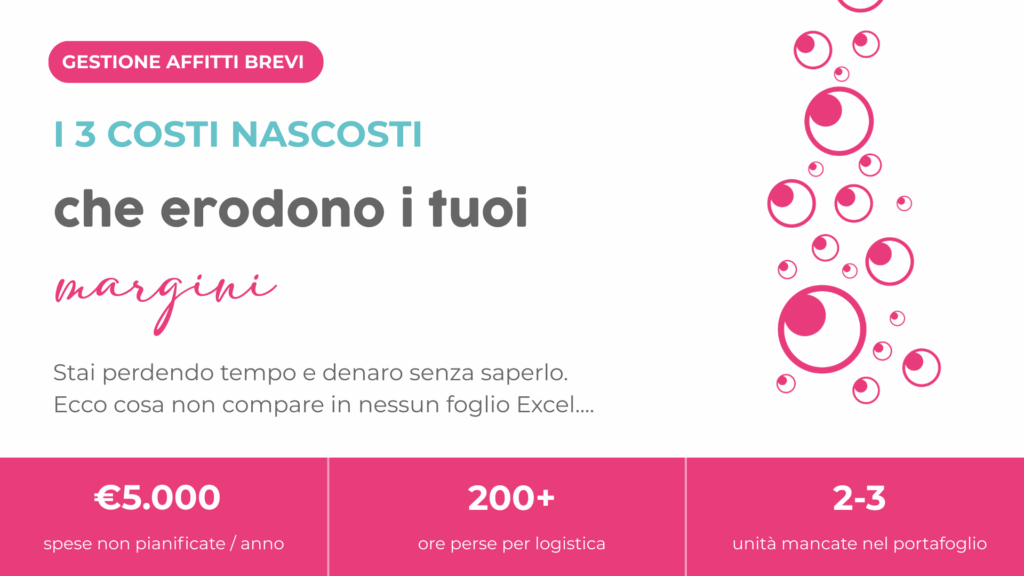
When you really break it down, three cost categories emerge that silently erode your margins—and no Excel spreadsheet is showing them to you.
Table of Contents
1. Sunk Costs: What You Don’t See Is Draining Your Revenue
Utility bills, detergents, travel expenses, and linens replaced ahead of schedule. These are the hidden costs of DIY logistics: real, recurring, and difficult to forecast.
Let’s start with the simplest case: a studio apartment with one double bed. For every checkout, you handle a full linen set: sheets, duvet cover, pillowcases, and towels. This involves about an hour of labor—covering washing, drying, and preparation—and costs around €17-18 when factoring in energy, detergents, and fabric depreciation.
It seems sustainable.
Add a second double bed, and the items to manage double: labor time increases to 2 hours per turnover, and the cost reaches €35.24. Over 100 checkouts, we’re talking about €3,524—€324 of which is for linen replacement alone. It’s a line item that almost no one budgets for, yet it kicks in like clockwork.
More importantly: with back-to-back checkouts on the same day, those two hours no longer fit into your available window. The washing machine is still running when the next guest knocks at the door. That’s not bad luck—it’s a structural limitation of in-house management. And it surfaces exactly during peak occupancy, right when mistakes are the most costly.
💡 How to Turn Variable Costs into Fixed Costs
Partnering with a specialized provider transforms these expenses into a fixed, predictable cost that—for VAT-registered businesses—is fully tax-deductible. You’ll know exactly what you’re spending per unit every month, making financial planning finally possible.
2. Peak Costs: The Price You Pay When Under Pressure
August, bank holidays, and the mid-August rush. These are the times when your calendar is fully booked, and in-house linen management shifts from being a minor hassle to a major expense.
When bookings overlap and inventory runs low, makeshift solutions come with a specific price tag: an emergency Ikea run for extra sets, time wasted hunting for a laundromat open on Sundays, or a frantic dash across town to deliver clean linens before check-in. These expenses never appear in any budget, but they drain your bank account every single time.
On top of this, there is the ‘information cost‘: every time you face a new scenario, calculating how much linen to order, where to source it quickly, or how to handle an emergency, you are paying in time and stress to solve a problem that will inevitably recur next season.
💡 During peaks, the real cost isn’t the linen: it’s managing the unexpected.
A specialized partner isn’t just essential because they scale with you. They are essential because they eliminate the cost of every single logistical decision you currently make under pressure.
3. Opportunity Cost: You Are Misinvesting Your Time
The cost no one calculates
This is the most underestimated cost, and simultaneously the most significant. Every hour spent coordinating pickups, deliveries, and quality control is an hour stolen from what truly scales a portfolio: optimizing rates, negotiating for new properties, and building relationships with owners.
A concrete example
A property manager overseeing 10 units who spends 5 hours a week on logistics is sacrificing over 200 hours a year of high-value activity. If reinvested strategically, those hours could translate into 2 to 3 additional units in their portfolio, directly boosting annual revenue.
Opportunity cost isn’t measured by direct expenses. It’s measured in missed growth.
The Solution: A Specialized Partner for Short-Term Rental Logistics
- Synchronized delivery and pickup coordinated with your booking calendar—zero manual management required.
- High-quality linen, always ready, without the need to invest in stock or equipment.
- Fixed, transparent, and easily trackable costs.
- Immediate scalability during peak periods, without hiring additional staff.
- Zero bottlenecks, even with 20+ units active simultaneously.
Logistics is not your profession. Your profession is delivering exceptional hospitality.
If you manage multiple units and feel that logistics are draining both your time and your margins, it’s time for an honest assessment of your true costs. Sunk costs, seasonal inefficiencies, and opportunity costs are three invisible brakes acting on your business every day—often without you even realizing it.
Outsourcing the logistics of your short-term rentals to a specialized partner is not an additional expense. It is a direct investment in your ability to scale.
Discover how bnbkit can optimize your logistics
FAQ
What is logistics management in short-term rentals?
When does outsourcing make sense?
Generally, the economic break-even point is reached at around 4 to 5 managed units. Beyond this threshold, in-house costs—including staff, equipment, and coordination—tend to exceed the fees of a specialized external service.
However, outsourcing can make sense even below this threshold. For those managing 1 to 3 apartments, the primary advantage isn’t direct savings: it’s predictability and time freedom. Knowing exactly how much you spend per unit, without the headache of managing emergencies, last-minute purchases, or peak-weekend logistics, has real value—especially for those just starting out or those who want to keep short-term rentals sustainable without them becoming a second job.

